
You know the pattern. You post hard for two weeks, life gets loud, and the account goes silent for a month. Then you start again from zero, a little more discouraged each time.
If you have been searching for how to post consistently, here is the honest answer: consistency is not a motivation problem, it is a systems problem. The creators who never seem to miss are not more disciplined than you. They post from a system that keeps running while they are busy, tired, or away from their desk.
This guide builds that system. Not a pep talk about content consistency, but the moving parts that make it real: content batching, a content pool that leads your calendar, a posting schedule you can actually keep, and a repurposing habit that turns one filming session into a week of posts. You set it up once, and a busy week stops being the thing that ends your streak.
Why consistency breaks, and why willpower is not the fix
Most advice tells you to want it more. That is exactly why it fails. Relying on willpower to make something new every single day is a plan that holds until the first hard week, and there is always a hard week.
The deeper problem is switching. When you create in scattered moments between other work, every start pays a tax. Research from the University of California, Irvine, cited by Asana, found it can take around 23 minutes to refocus after an interruption. Ten stolen minutes here and there do not add up to a finished video. They add up to ten cold starts.
There is a quieter cost too. When you appear and vanish, your audience learns not to count on you, and the trust that consistency builds never gets a chance to compound. The start and stall loop does not just cost you posts. It resets the relationship every time. So the fix is not more grit. It is to stop making today's post with today's energy. A good system moves the hard thinking into one calm block and leaves your busy days almost empty.
The core idea: post from a buffer, not from today
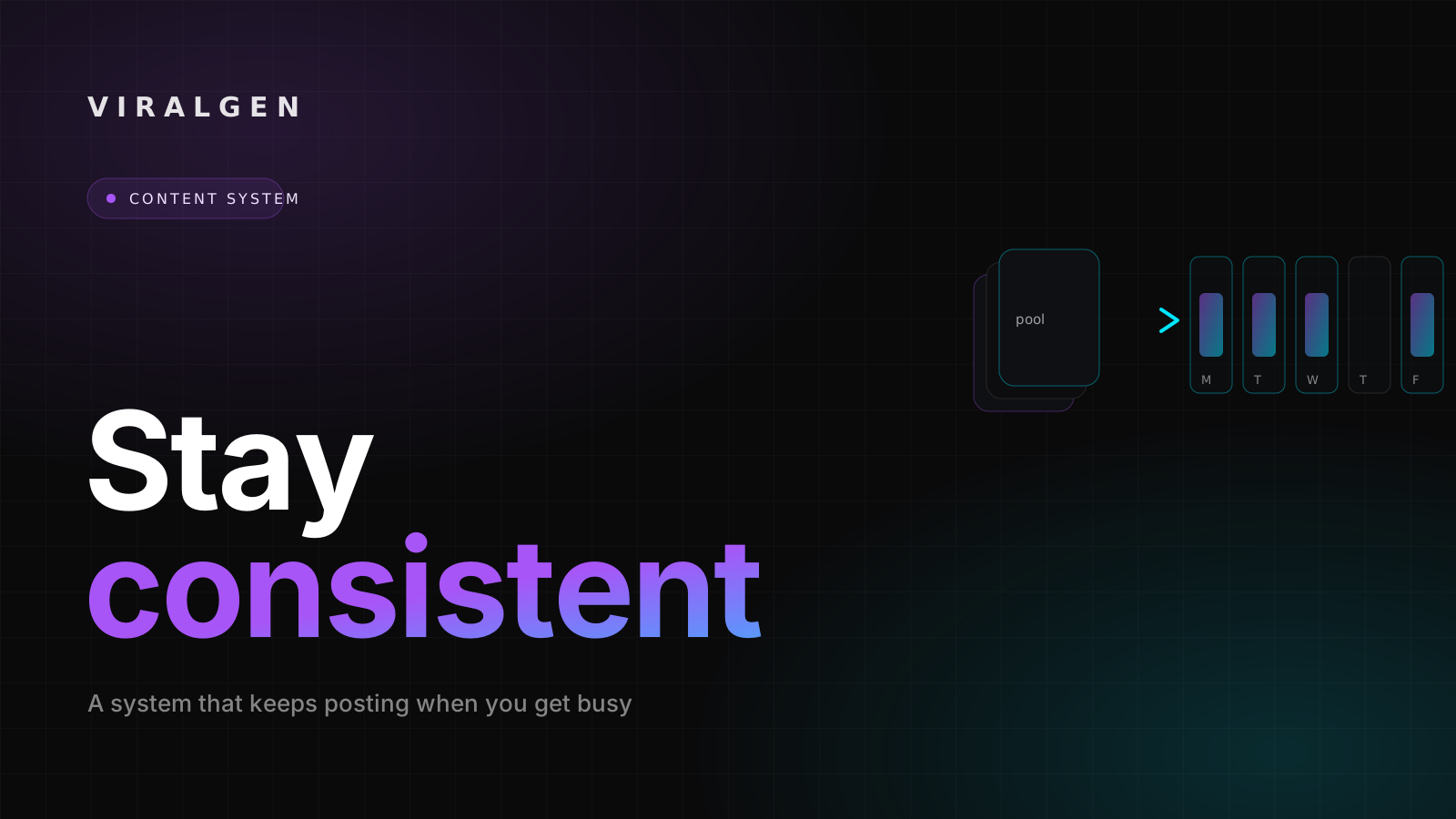
Here is the single shift that changes everything. Stop asking "what do I post today." Post from a pool of content you already made. Think of it as a buffer that sits in front of your calendar. When the pool is full, a skipped batch day costs you nothing, because next week is already sitting there ready to go. The calendar never draws on your energy on the day. It draws from work your past self already finished.
This is the quiet engine behind accounts that never miss, and it is exactly how ViralGen is built: a content pool that leads the calendar, so the schedule is always fed from a queue rather than from a scramble. You can see how the planning and scheduling side works, but the principle stands whatever tool you use. Fill the pool first. Let the calendar pull from it.
Scrambling daily (willpower)
- Decide what to post this morning
- Film, edit, and publish in one rushed sitting
- A busy day means no post at all
- Every start pays the refocus tax
- One missed day breaks the streak
Posting from a buffer (system)
- Ideas and clips are already made
- The calendar pulls from a ready pool
- A busy day still ends in a post
- The hard thinking was done in one batch block
- The buffer absorbs the bad week
Same posting goal, two completely different failure modes on a busy week.
How far ahead should the pool run?
There is no universal number, so treat these as rules of thumb rather than laws. A week of finished posts is the floor, enough that one bad day cannot leave a gap.
Two weeks is comfortable, enough that a genuinely busy stretch passes without anyone noticing. A month is a cushion, the point where a rough patch in your life becomes barely noticeable on your feed. The exact size matters less than the habit. Whatever number you pick, refill the pool before it empties, not after it runs dry.
Build your content system in five steps
A durable system has five parts. Set up each one and posting becomes something your week does on its own, not something you have to summon.
- Batch the making. Group like tasks and do them in one focused block. Script several pieces at once, then film several, then edit several, rather than dragging a single clip from idea to posted every day. This is content batching, and Buffer frames it plainly: batching lets you save time, stay consistent, and take days off, because there is always something ready to go.
- Keep a running idea list. Never open the camera to a blank mind. Keep one note where ideas land the moment they hit, so batch day starts full instead of empty. Feed that list from what is already working: our guide to finding viral content ideas goes deeper, and ViralGen's viral content discovery surfaces short form that is already outperforming, scored by views against a creator's follower count.
- Fill a pool that leads the calendar. Turn batched work into a queue of finished, ready posts, and keep it a set number ahead. This buffer is the part that survives the busy week, so guard it more than any other step.
- Put it on a calendar. Decide your slots once, not every morning. A simple content calendar removes the daily "should I post" debate. As Sprout Social notes, planning by the month or quarter saves you from hunting for something to say every single day.
- Shrink the posting step. Make the actual publish the smallest action in the whole system. When posting is a single tap rather than a project, it still happens on the day everything else goes wrong. ViralGen reduces that last step to an iOS Shortcut, so the final push takes seconds, not focus.
Notice what this does. Every hard decision now lives in one block. The other days ask almost nothing of you.
A weekly rhythm that survives a busy week
A system needs a heartbeat. Here is a rhythm you can hold even when the week turns against you.
- One batch day. Block a few hours a week, or a longer session every two weeks, and film several pieces back to back. This is the one appointment you protect no matter what.
- A daily idea pass. Spend a few minutes most days adding to the idea list. Low effort, high payoff, and it keeps batch day from ever starting cold.
- A midweek audit. Once a week, review what you batched, write captions, and load it into the queue. This is where quality control lives, away from the pressure of the day.
- Posting as a tiny task. Publishing should take a couple of minutes at most, ideally automated or down to one tap.
- A monthly refill check. Glance at the pool and the calendar once a month. If the buffer is running low, add a batch session before it empties, not after.
Only one item on that list, the batch day, needs real energy. Everything else is light enough to do on a bad day, which is the entire point.
Repurpose so one shoot becomes many posts
Consistency gets far cheaper when one piece of work becomes several posts. Buffer lists repurposing across platforms as one of the main payoffs of batching, and it is where your hours multiply.
One shoot, several angles
A single filming session can feed Instagram Reels, TikTok, and YouTube Shorts, each cut and captioned for its home instead of the same file dropped everywhere. Beyond platforms, one idea usually holds several posts: a different hook on the same footage, a shorter cut, a follow up that answers the comments the first one earned. You are not making more content so much as getting more posts out of the content you already made.
Keep a recognizable through line
Repurposing works best when your content has a recognizable through line. A steady format and a consistent on screen presence let you remix freely without looking scattered.
This is the idea behind ViralGen's persona approach: it recreates winning short form with a consistent AI persona and audits every clip before it reaches your queue, which is especially useful for a faceless creator who wants a stable identity without filming their own face every time. One idea, one voice, many posts.
When the busy week hits, protect the system
Every plan eventually meets the week from hell. The point of the buffer is that this week is exactly what it was built for. When life explodes, do three things. Draw down the pool and let your past self carry the schedule. Lower the bar without lowering the streak, because a plain post that ships beats a perfect one that never does.
And defend the single batch block on your calendar, even a shorter version of it, so the pool refills before it runs dry.
That last habit is worth guarding hard. Todoist describes time blocking as reserving protected blocks for focused work, and cites Cal Newport's estimate that a structured, time blocked week can produce as much as a far longer unstructured one. Your batch block is that protected time. Keep it, and the system keeps you.