
If you are running or planning an AI influencer, the real question is simple: how AI influencers make money, and how much of it is realistic. This guide answers that honestly. There is real money in AI influencer income, but it does not arrive on day one, and the get rich quick promises you see are mostly noise.
One thing to say up front. Reliable public earnings data for AI influencers specifically is thin. Very few operators publish audited numbers, and the ones who do are not representative. So this guide keeps earnings qualitative, points you to the platform rules that are actually verifiable, and shows you the order to build income in. If you want to monetize an AI influencer, start with the audience, then layer the money on top.
The honest truth about AI influencer income
Here is the mental model that keeps you sane. An AI influencer does not earn because it was made with AI. It earns because it has an audience that trusts it, in a niche where that trust is worth something. The AI part changes how you produce, not why people pay.
That means the audience is the asset. Every income stream below is a way to convert attention into money, and none of them work without attention first. This is why AI creator money follows the same curve as any creator business: slow, then compounding, with most of the value arriving after you have a consistent body of work. So treat the early months as building, not earning.
If you optimize for a payout before you have an audience, you will pick the wrong niche and burn out before the money was ever going to show up.
The real income streams
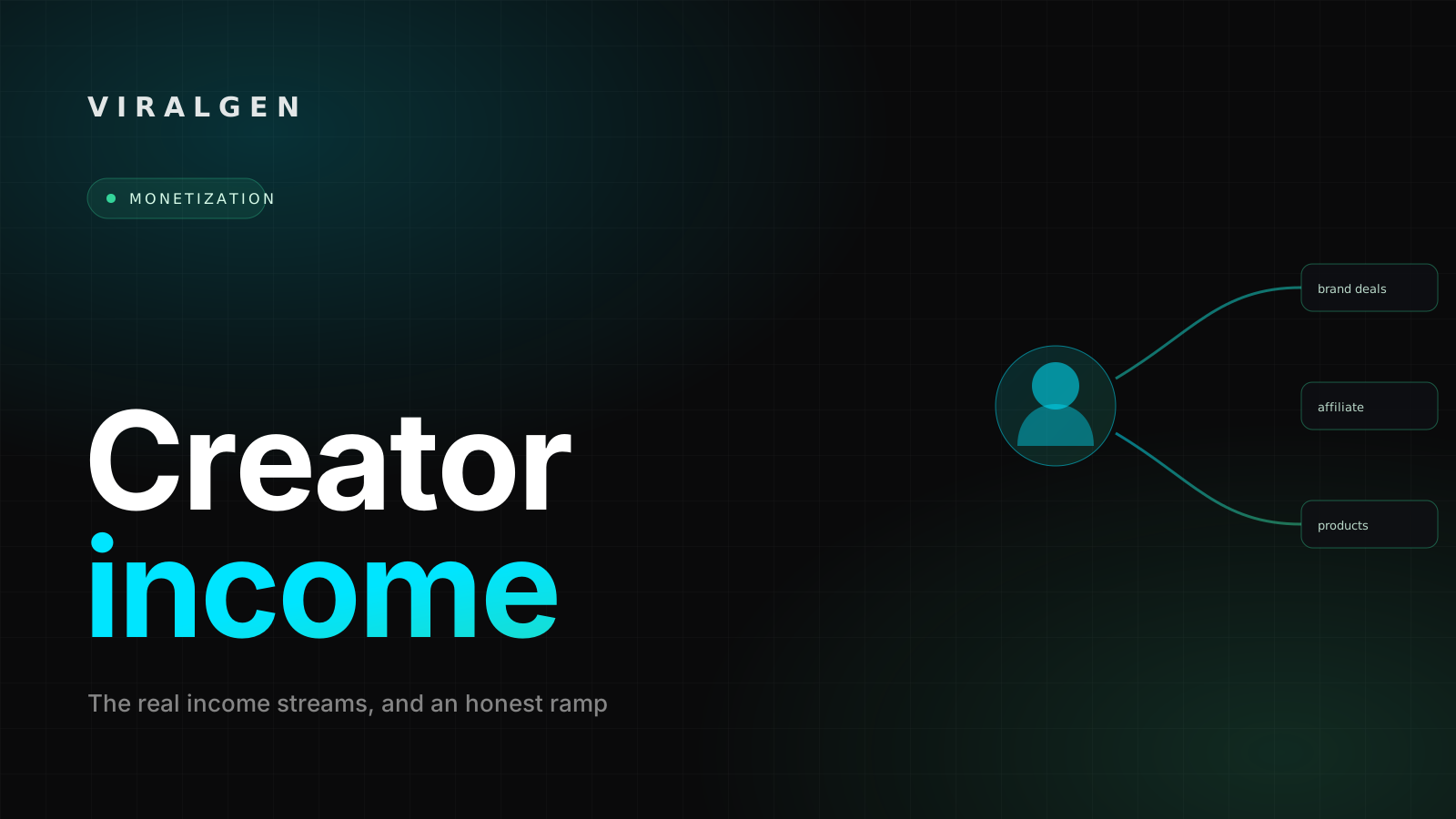
There are five income streams that actually matter. Most established creators run several at once, because any single one is fragile.
- Brand deals and sponsorships. A brand pays your persona to feature a product or run a campaign. This has the highest ceiling once you have an engaged, well defined audience, and it is also the stream where disclosure rules bite hardest. It pays later, because brands want proof before they spend.
- Affiliate income. You share a link and earn a commission when someone buys through it. It is easy to start and pays only when people actually purchase, so it rewards relevance over raw reach. A smaller audience that trusts your recommendations can outperform a much larger one that does not.
- Your own products. Digital templates, presets, a course, merch, or a paid community. You keep most of the margin and you own the customer relationship, which is the most durable position of all. It takes the most work to build, so it usually comes later.
- Content services and UGC ads. You point your production skills at other brands rather than only at your own channel. This can pay before your own audience is large, which makes it a useful bridge. See our guide to AI UGC ads for how that market works.
- Platform funds and ad revenue. The platforms themselves pay eligible creators. This is the one stream with published, checkable rules, so it is worth being precise about.
Platform funds: the numbers you can actually verify
Two programs are worth naming, because their eligibility is public. On YouTube, the Partner Program is the gateway to ad revenue sharing. To join, you need 1,000 subscribers plus either 4,000 valid public watch hours in the last 12 months or 10 million valid public Shorts views in the last 90 days, and your channel still has to pass a policy review and be linked to AdSense.
The current rules live on the YouTube Partner Program page. On TikTok, the Creator Rewards Program pays for longer posts. Eligibility calls for at least 10,000 followers, at least 100,000 video views in the last 30 days, an age of at least 18, and a personal account, and eligible videos must be at least one minute long. Check the terms on TikTok's own Creator Rewards page. Two honest caveats.
These thresholds change, so treat the official pages as the source of truth, not this article. And per view payouts swing widely by country, niche, and season, so be skeptical of any confident "earn X per 1,000 views" claim.
| How it works | Effort to start | When it pays | |
|---|---|---|---|
| Brand deals | A brand pays your persona to feature a product | High, needs a proven audience | Later, after reach and trust |
| Affiliate | A commission when viewers buy through your link | Low | As people buy, scales with relevance |
| Own products | Digital products, courses, merch, a community | High | Medium term, best margins once built |
| Content services | You make short video for other brands | Medium | Early, before your own audience is large |
| Platform funds | YouTube Partner Program, TikTok Creator Rewards | Medium, eligibility gated | After you meet the thresholds |
Most creators run several at once, because any single stream is fragile.
What is actually realistic
No two channels ramp the same way, so read the following as a shape, not a schedule. Some niches move faster, many move slower, and plenty never reach brand deal scale. The point is the order.
- Months 0 to 2, build only. Lock your persona, pick a niche, and post consistently. Expect no income. Your only job is finding formats that land and hitting real post volume.
- Months 2 to 4, first small money. Once a small, engaged audience exists, add affiliate links that genuinely fit your niche and test one simple product. Apply to platform funds only when you actually meet the published thresholds above.
- Months 4 to 8, brand conversations. With clear numbers and an obvious niche, you can start pitching or fielding brand deals. Keep layering your own products, since they pay the most per customer.
- Beyond, diversify. The goal is that no single stream is your whole income. That is what turns an AI influencer into a stable business rather than a lucky streak.
Notice that money is layered on top of an audience, never the other way around. If you want the audience building playbook first, our guides to creating an AI influencer and running a faceless content channel cover it.
Disclosure rules you cannot skip
Monetizing an AI influencer comes with two separate disclosure duties. They are different rules, and you owe both.
Sponsorship disclosure (the FTC)
In the United States, the FTC requires you to disclose any material connection to a brand: paid promotions, free products, discounts, or a family or employment relationship. The value does not matter, a free item still counts. Disclosure has to be clear and conspicuous, which means it belongs at the start of the post, inside the caption before the "more" cutoff, and ideally spoken or shown in the video itself.
Vague tags like "spon" are not enough, and platform tools alone are not enough. Worth knowing: brands share the liability when disclosure fails, so serious partners will expect you to get this right. A plain reading is in this FTC disclosure summary.
Platform AI labeling
Separately, the platforms want you to label realistic AI content. YouTube, for example, asks you to disclose altered or synthetic content that makes a real person appear to say or do something they did not, alters footage of a real event or place, or shows a realistic scene that did not happen.
It does not ask you to flag clearly unrealistic content, beauty filters, or behind the scenes help like scripts and captions, and importantly, disclosing does not shrink your reach or your earnings. The details sit on YouTube's altered or synthetic content page. TikTok and Meta run their own AI labels, so check every platform you post to.
The likeness rule: own your persona
This is the rule that quietly protects your whole business. Build your AI influencer around a persona you own, generated from a reference you have the rights to use. Never build it on a real person's face or voice without their explicit consent, because that is where legal and platform risk turns real, and where an account can vanish overnight.
A consistent, locked persona helps here in a practical way: it is a character you control rather than a real individual you are imitating. Our AI persona feature exists for exactly this reason, keeping one identity stable across every clip you publish.
Where ViralGen fits
Every income stream above rewards the same two things: consistent output and a persona your audience recognizes. That is the gap ViralGen is built to close.
It runs one pipeline: it finds short form that is already going viral, scored by views against followers so you copy proven formats instead of guessing, recreates that format with a consistent AI persona locked from your reference, audits every clip before it goes out, then schedules the result to Instagram Reels, TikTok, and YouTube Shorts.
The monetization payoff is indirect but real: the faster you can ship recognizable, on niche content, the sooner you reach the audience size that every income stream depends on.